
Production and Propagation of Sound
Sound is a form of energy that is produced when an object vibrates, and it needs a material medium (like solid, liquid, or gas) to travel, or propagate, from one place to another.
Key points that govern production and propagation of sound:
- Sound is produced only when an object vibrates; it stops the moment vibration stops.
- The vibrating object that produces sound is called the source of sound.
- Sound can propagate through solids, liquids, and gases.
- Sound cannot propagate through a vacuum, since there is no matter to carry the vibration.
- The material through which sound travels from source to listener is called a medium.
What Produces Sound?
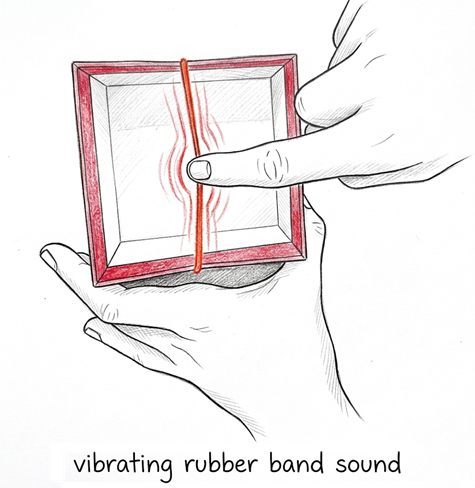
Vibration is the periodic to-and-fro motion, or oscillation, of an object. Sound is produced whenever an object vibrates, and it stops as soon as the vibration stops. This simple link between vibration and sound can be checked directly with a stretched rubber band.
Activity: Vibrating Rubber Band Produces Sound
Sound is produced only for as long as the object keeps vibrating.
Pulling a stretched string or striking a metal object makes it vibrate, and this vibration produces sound.
Blowing through a bansuri (flute) makes the air column inside the hollow pipe vibrate, which produces sound. In general, sound can be produced by vibrating strings, membranes, air columns, and many other vibrating objects.
In most musical instruments, more than one vibrating part is involved in producing the sound.
How Humans and Animals Make Sound
In humans and some other animals, sound is produced by the vibration of vocal cords — tightly stretched muscular flaps inside the voice box, or larynx, in the throat. The tongue, lips, mouth, and nasal cavity then help convert this sound into speech or music.
Some animals, such as grasshoppers and crickets, produce sound by striking or rubbing certain body parts, like their wings or legs, against each other.
The Tuning Fork: A Simple Tool to Study Vibration
A tuning fork is an instrument often used for sound experiments. It is a U-shaped metal bar with a stem, usually made of steel or aluminium. The two sides of the U are called prongs, or tines, and they are struck against a pad to make them vibrate.
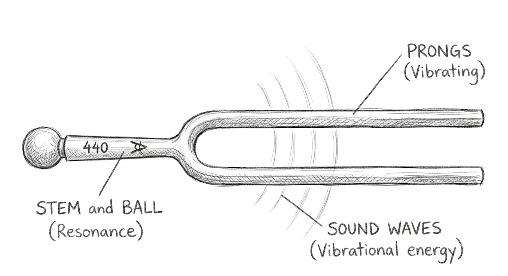
Activity: Tuning Fork and Vibrations
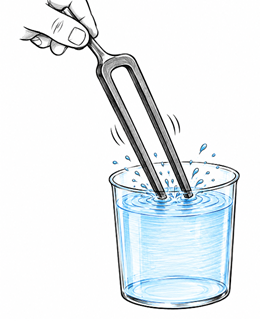
A sound is heard near the ear, and the prong makes waves on the water surface — confirming that a struck tuning fork’s prongs are vibrating, and this vibration produces the sound.
Propagation of Sound Through Solids, Liquids and Gases
Sound reaches our ear from its source by travelling, or propagating, through the air around us. But sound can also propagate through solids and liquids, not just through gases like air.
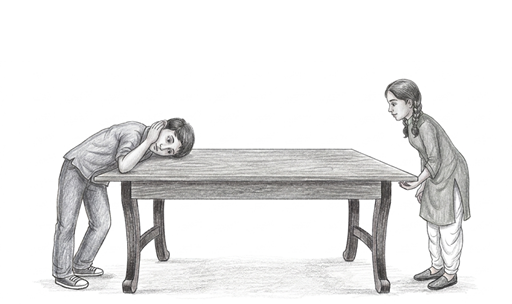
Activity: Sound Travelling Through a Solid
Activity: Sound Travelling Through Water
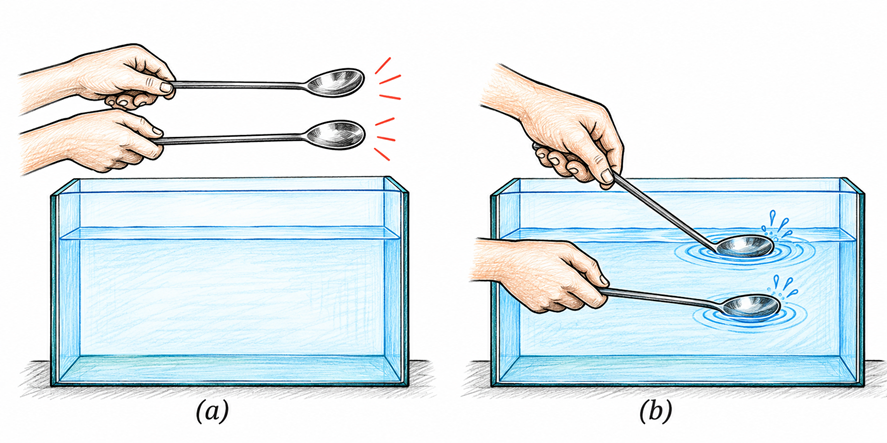
Two metal spoons being tapped together in air and again while submerged in water, to show sound travels through liquids too.
Since sound can travel or propagate through solids, liquids, and gases, the material through which sound propagates is called a medium.
A space where there is no medium, that is, no matter at all, is called a vacuum.
Why Sound Cannot Travel in a Vacuum
A vacuum has no matter in it, so there is nothing to vibrate and carry the sound forward. This is demonstrated with the classic vacuum bell jar experiment.
Activity: Vacuum Bell Jar Experiment
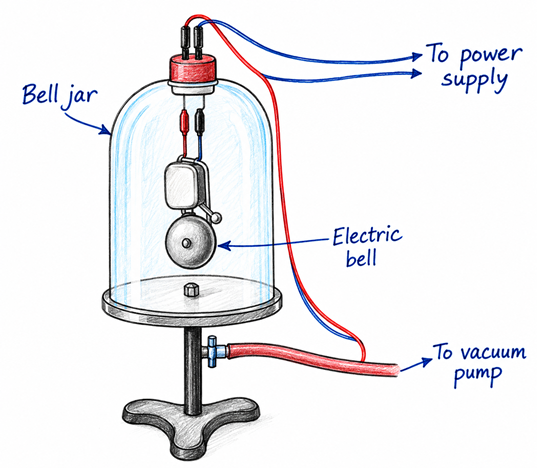
This experiment shows that sound cannot propagate in a vacuum — it needs a medium, which can be a solid, a liquid, or a gas.
Special Case: Why Astronauts Cannot Hear Each Other Directly in Space
Outer space is close to a vacuum, so sound cannot propagate there. This is why astronauts on a spacewalk cannot directly hear each other speak, or hear sounds such as two metal objects clanking together, even while working side by side. Instead, they communicate using special devices fitted inside their spacesuits.
Solved Examples
Example 1
Assertion (A): We cannot hear the sound of a bell ringing in a closed jar after most of the air is pumped out.
Reason (R): Sound requires a medium to travel.
Answer: Both A and R are true, and R correctly explains A. Once most of the air is removed from the jar, there is almost no medium left inside it, so the vibrations of the bell cannot reach us as sound.
Example 2
Question: Two students test whether sound travels through liquids using two metal spoons and a tub of water. What should they observe, and what does it prove?
Answer: They should still hear the sound of the spoons tapping even after submerging them in water, without letting the spoons touch the container. This proves that sound can travel through liquids, not just through air.
Frequently Asked Questions
What is vibration in the context of sound?
Vibration is the periodic to-and-fro motion, or oscillation, of an object. Sound is produced only while an object is vibrating, and it stops when the vibration stops.
What is the source of sound?
The vibrating object that produces sound is called the source of sound. It can be a stretched string, a membrane, a column of air, or any other object that is set into vibration.
Can sound travel through solids and liquids, or only through gases?
Sound can travel through solids, liquids, and gases. Activities with a wooden desk and with spoons tapped underwater both show that sound reaches a listener through solids and liquids as well as air.
Why can’t sound travel in a vacuum?
Sound needs a medium — matter that can vibrate and carry the disturbance forward. A vacuum has no matter in it, so there is nothing to vibrate, and sound cannot propagate through it.
Why can’t astronauts hear each other directly during a spacewalk?
Outer space is nearly a vacuum, so there is no medium for sound to travel through. This is why astronauts cannot hear each other speaking, or metal objects clanking together, without using special communication devices in their spacesuits.
