
A frame of reference is a setup that gives an origin (starting point), coordinate axes (directions), and a clock, which together allow us to describe the position and motion of objects.
Since space itself has no fixed point or direction, motion can only be measured relative to a chosen reference frame.
- inertial (at rest or moving at constant velocity) or
- non-inertial (accelerating),
This is a distinction that determines whether Newton’s laws of motion apply directly or require a pseudo force.
Frames of reference
Physics, as we all know, is the study of physical phenomena in nature. We also know that the mechanical motion of bodies is the simplest form of physical phenomenon in nature. We are familiar with the concept of a point object. According to this, the size of the body under study can be neglected when describing its motion.
Now, if we want to know the motion of this point object or material body. To do this, we must have some knowledge of its position in space at every instant of time. For this, we need a reference point, or frame of reference. With respect to this reference point, we can observe the motion of the object. This is what we will explore in this article.
Introduction
We know that space, when not under the influence of large objects like stars and planets, is uniform and isotropic. This means that all points in space are equivalent, and all directions in space are also equivalent.
Since space has no preferred location and no preferred direction, we cannot use it as a reference for determining the position of a particle. Instead of using space as a reference point, we determine the position of one body with respect to another body.
To understand this further, consider the example of a pot in a room. We can determine its position by measuring its distance from the floor and from two mutually perpendicular walls.
In general, our experience shows that we need to specify three coordinates in order to completely define the position of a particle in space with respect to a chosen reference point.
What is a Frame of Reference?
So, what exactly is a frame of reference?
A frame of reference is a body which is regarded as fixed for a given problem, and with respect to which the positions of all other bodies are specified.
While any object — for example, Earth, the Moon, or a tree — can serve as a frame of reference, some frames are more convenient than others for a given problem. For instance, when analyzing the motion of a bicycle, we would find a frame of reference attached to Earth far more convenient than one attached to the Sun or the Moon.
The figure below shows a reference frame with three mutually perpendicular straight lines, known as the axes of the coordinate system. This is called a Cartesian coordinate system.
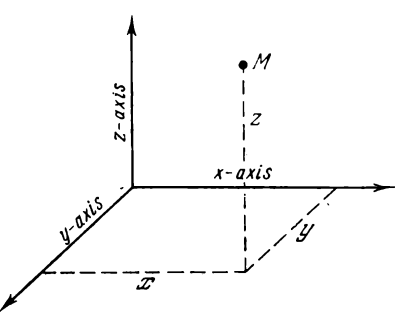
Any point in space can be located by determining its three coordinates with respect to the origin of the reference system. The three coordinates required to find the position of any point in space are:
- x-coordinate
- y-coordinate
- z-coordinate
The state of rest or motion of any object under observation is specified with respect to our chosen frame of reference. An object is said to be at rest if it occupies the same position in the frame of reference as time passes. The object is said to be in motion if its position changes with time.
At this point, it is important to note that:
- All observations and measurements in physics are made relative to a frame of reference.
- A suitable frame of reference is chosen for making observations and measurements while solving problems in physics.
- When making observations for future predictions, it is essential to note the frame of reference from which the observations were made.
Observer and frame of reference: An observer describes the position and motion of an object with respect to a chosen frame of reference. Different observers using different frames may assign different positions or velocities to the same object.
Ground Frame and Lab Frame
Before we go further, let us also look at two terms that come up often in numerical problems.
Ground Frame
When a frame of reference is fixed to the Earth’s surface, we call it the ground frame. This is the frame we use by default in most everyday problems, such as finding the speed of a car or the range of a projectile.
Lab Frame
Similarly, when a frame of reference is fixed to the laboratory or the point from which we are conducting an experiment, we call it the lab frame. In most cases, we treat the lab frame the same as the ground frame, unless the lab itself happens to be accelerating, for example, if it is set up inside a moving vehicle.
So, unless a problem tells us otherwise, we can assume that quantities like velocity and displacement are being measured with respect to the ground frame.erwise, quantities like velocity and displacement are usually assumed to be measured with respect to the ground frame.
Inertial and Non-Inertial Frames of Reference
Now, not all frames of reference behave the same way when it comes to Newton’s laws of motion. Based on this, we classify frames of reference into two types.
- Inertial frame of reference: A frame that is either at rest or moving with constant velocity, that is, it has zero acceleration. In such a frame, Newton’s first law holds true in its simple form — a body continues in its state of rest or uniform motion unless an external force acts on it. For most everyday purposes, we treat a frame attached to the ground as an inertial frame.
- Non-inertial frame of reference: A frame that is accelerating. Here, Newton’s laws do not hold true in their simple form unless we also introduce what is called a pseudo force (or fictitious force) to account for the acceleration of the frame itself. A car that is speeding up, slowing down, or turning is a good example of a non-inertial frame.
This distinction turns out to be quite important as we move ahead to topics like circular motion and the application of Newton’s laws of motion, where the frame we choose directly affects which forces we need to account for.
Relative Motion and Relative Velocity
Since we now know that the position and motion of an object depend on the frame of reference we choose, it follows that the same object can appear to move differently to two different observers, if they happen to be in different frames. This is what we mean by relative motion.
The relative velocity of an object A with respect to another object B is simply the velocity of A as it would be measured by an observer moving along with B, that is, an observer sitting in B’s frame of reference. For motion along a straight line, we can write this as:
vAB = vA − vB
Here, vAB is the velocity of A relative to B, vA is the velocity of A with respect to the ground frame, and vB is the velocity of B with respect to the ground frame.
Let us take an example
Suppose a person is walking at 5 km/h towards the front of a train, and the train itself is moving at 60 km/h with respect to the ground. We want to find the velocity of the person (a) with respect to the ground, and (b) with respect to someone sitting still inside the train.
Let us take the direction in which the train is moving as positive.
- Velocity of the train with respect to the ground, vtrain = 60 km/h
- Velocity of the person with respect to the train, vperson, train = 5 km/h
(a) Velocity of the person with respect to the ground
vperson, ground = vtrain + vperson, train = 60 + 5 = 65 km/h
This is because, as seen from the ground, the person’s overall motion is a combination of the train’s motion and their own walking motion within it.
(b) Velocity of the person with respect to someone sitting inside the train
Since the seated person shares the same frame as the train, this is simply vperson, train = 5 km/h.
What this example tells us is that the same motion can have two different, but equally correct, velocity values, depending on which frame we are observing from. Neither of these answers is wrong — they are just describing the motion relative to two different frames.
Relating Two Inertial Frames: Galilean Transformation
Consider two inertial frames of reference, $S$ and $S’$, moving with a constant velocity $V$ relative to each other along the $x$-axis.
The position, velocity and time measured by an observer in one frame can be related to the corresponding measurements made by an observer in the other frame.
These relations are called the Galilean transformation equations. They are used in classical mechanics to transform the position and velocity of an object from one inertial frame to another.
If the origins of the two frames coincide at $t=0$, the position coordinates are related byx′=x−Vtx’ = x – Vt
For the other two coordinates,y′=y,z′=zy’ = y, \qquad z’ = z
In classical mechanics, time is considered absolute, so both observers measure the same time:t′=tt’ = t
Differentiating $x’ = x – Vt$ with respect to time gives the velocity transformation:vx′=vx−Vv’_x = v_x – V
or, equivalently,vx=vx′+Vv_x = v’_x + V
Thus, the velocity of an object has different values in two inertial frames, even though the acceleration remains the same:ax′=axa’_x = a_x
This is the mathematical basis of relative velocity in classical mechanics. It shows that position and velocity depend on the chosen reference frame, while acceleration remains unchanged when we transform between two inertial frames moving with constant relative velocity.
References and further reading
- B. M. Yavorsky, A. A. Pinsky – Fundamentals of Physics. Vol. 1, MIR Publishers (1975)
- Rest and Motion in Physics
- Isotropy and Uniformity in Space
- Uniformity of Time in Physics
Frequently Asked Questions
What is a frame of reference in physics?
A frame of reference is a body that is regarded as fixed for a given problem, with respect to which the positions of all other bodies are specified.
Why do we need a frame of reference to describe motion?
Space itself is uniform and isotropic, meaning it has no preferred location or direction, so it cannot be used as a reference. Instead, the position of one body must be described with respect to another body chosen as the frame of reference.
How many coordinates are needed to specify the position of a point in space?
Three coordinates — the x-coordinate, y-coordinate, and z-coordinate — are needed to completely define the position of a particle in space with respect to a chosen reference point.
What is a Cartesian coordinate system?
A Cartesian coordinate system is a reference frame made up of three mutually perpendicular straight lines, called axes, used to locate any point in space relative to an origin.
How is a state of rest or motion determined using a frame of reference?
An object is in a state of rest if it occupies the same position in the chosen frame of reference over time, and in a state of motion if its position changes with time.
Can any object be used as a frame of reference?
Yes, any object such as the Earth, the Moon, or a tree can serve as a frame of reference. However, some frames are more convenient than others depending on the problem being analyzed — for example, a frame attached to Earth is more convenient than one attached to the Sun when studying everyday motion.
What is the difference between the ground frame and the lab frame?
The ground frame is a frame of reference fixed to the Earth’s surface, while the lab frame is fixed to the laboratory or the point from which we are observing. We treat the two as the same, unless the lab itself happens to be accelerating.
What is the difference between an inertial and a non-inertial frame of reference?
An inertial frame of reference is one that is either at rest or moving with constant velocity, so Newton’s laws hold true in their simple form. A non-inertial frame, on the other hand, is one that is accelerating, and here Newton’s laws hold true only if we introduce a pseudo force to account for the frame’s own acceleration.
Can you give an example of an inertial and a non-inertial frame of reference?
We generally treat a frame attached to the ground as an inertial frame for everyday problems. A car that is accelerating, braking, or turning is a good example of a non-inertial frame — an object inside it seems to experience a force, even though no real force is acting on it in that direction.
What is relative velocity?
Relative velocity is the velocity of one object as measured by an observer moving along with another object, that is, the velocity of the first object in the second object’s frame of reference. We calculate it as vAB = vA − vB, where vA and vB are the velocities of the two objects with respect to a common frame, such as the ground.
What is the Galilean transformation?
The Galilean transformation is a set of equations that relates the position, velocity, and time of an object as measured in one inertial frame to its measurements in another inertial frame, when the two frames are moving at constant velocity with respect to each other.
