
Written by Rati Singhi (M.Sc. Physics, B.Ed.), founder of PhysicsGoEasy. Suitable for Class 9 to Class 11; level tags mark where the material gets harder.
1. What Is Motion in Physics?
Motion is a change in the position of an object with respect to a chosen frame of reference over time. Every measurement of motion depends on the observer, so motion is always relative and never absolute.
A passenger seated in a moving train is at rest relative to the seat and co-passengers, and in motion relative to a person on the platform. Both statements are correct, because each observer uses a different frame of reference. Before describing how something moves, you must state with respect to what it moves.
This page is the pillar for the motion topic within kinematics. Each section gives a working explanation, then a Go Deeper link to the full article with derivations and solved problems.
Where to start: Class 9 readers: sections 1, 2, 5, 6, 7 and 8. Class 10 readers: add the worked problems (section 10). Class 11 readers: add sections 3 and 4, which cover inertial frames, pseudo forces and the point-object idealisation.
Key terms at a glance
| Term | Definition |
|---|---|
| Motion | A change in position with respect to a chosen frame of reference over time. |
| Rest | No change in position with respect to a chosen frame of reference. |
| Frame of reference | A coordinate system, fixed to an observer, used to specify position and time. |
| Point object | An idealised body whose size is negligible compared with the distance it travels. |
| Distance | A scalar: the total length of the path travelled. |
| Displacement | A vector: the shortest straight-line change in position, with direction. |
| Speed / Velocity / Acceleration | Distance per unit time (scalar) / displacement per unit time (vector) / change of velocity per unit time (vector). |
2. Rest and Motion
Level: Class 9 onward. An object is in motion if its position changes with respect to a chosen frame of reference, and at rest if it does not. Both are relative states.
- A book on a table is at rest relative to the table but in motion relative to the Sun, because the Earth carries it through space.
- No known object is absolutely at rest, so no absolute standard of rest exists.
- “The car is moving” is therefore incomplete; “the car is moving with respect to the road” is complete.
| Basis | Rest | Motion |
|---|---|---|
| Change in position | Zero | Non-zero |
| Speed in that frame | Zero | Non-zero |
| Position-time graph | Horizontal line | Line or curve with non-zero slope |
| Nature | Relative in both cases, never absolute | |
→ Go Deeper: Rest and Motion in Physics
3. Frame of Reference
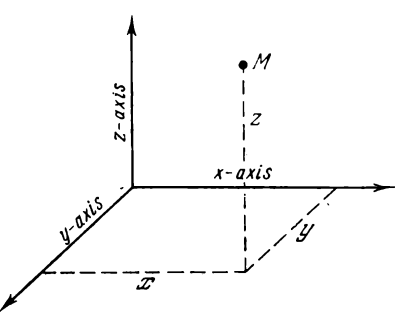
A frame of reference is a coordinate system, fixed to an observer, used to specify the position of an object and the time of an event. It needs three things: an origin from which positions are measured, a set of axes (usually x, y, z) that fix direction, and a clock. Coordinates mean nothing until the origin is stated, so two observers with different origins can disagree about whether an object moves, and both can be right.
→ Go Deeper: Frames of Reference in Physics
3.1 Inertial and non-inertial frames
Level: Class 11. A frame is inertial if Newton’s first law holds in it: a body with no net force stays at rest or moves with constant velocity. It is non-inertial if it is accelerating, so bodies seem to change velocity with no identifiable force acting.
| Basis | Inertial frame | Non-inertial frame |
|---|---|---|
| Acceleration of the frame | Zero | Non-zero |
| Newton’s laws | Valid as they are | Valid only after adding pseudo forces |
| Examples | Train at steady velocity on straight track; the ground (approximately, since the Earth rotates) | Braking car; merry-go-round; lift starting to move |
A pseudo force is a fictitious force introduced only inside a non-inertial frame so that Newton’s laws can still be applied. It has no source object and no reaction pair. When a car brakes, a ball on the back seat rolls forward: no one pushed it, it simply kept its velocity while the car slowed.
3.2 Isotropy and uniformity of space and time
Level: Class 11. Classical mechanics assumes that space is isotropic (same in every direction) and homogeneous (same at every point), and that time is uniform (a Newtonian assumption: it flows at the same rate everywhere, which relativity later revises). These assumptions are why you may shift the origin, rotate the axes or restart the clock in a problem and still get the same physics.
→ Go Deeper: Isotropy and Uniformity in Space · Uniformity of Time in Physics
4. The Point Object (Particle) Concept
Level: Class 11. A point object is an idealised body whose size is negligible compared with the distance it travels, so all its mass is treated as concentrated at one point. The approximation removes shape and rotation and leaves only translation.

- Valid when the object is tiny compared with the distance it covers, and its rotation is irrelevant. The Earth (radius about 6400 km) is a point object for its orbit (radius about 1.5 × 10⁸ km).
- Not valid when size is comparable to the distance moved (a car parking in a slot barely longer than itself), or when spin is what you are studying (a spinning top, the swing of a cricket ball).
- A 500 m train is a point object on a 500 km journey, but not while crossing a 600 m bridge.
→ Go Deeper: Point Object in Physics
5. Types of Motion
Level: Class 9 onward. Mechanical motion is the change in position of a body with respect to other bodies. It is classified by the path followed and by the rate of motion.
| Type (by path) | Description | Examples |
|---|---|---|
| Rectilinear | Straight-line path | Car on a straight road; a falling apple; a lift |
| Curvilinear | Curved path | A ball thrown at an angle (projectile) |
| Circular | Path is a circle | A stone whirled on a string; a satellite in circular orbit |
| Rotational | Body spins about an axis | Fan blades; a spinning top |
| Oscillatory | Repeats a to-and-fro path about a mean position | Pendulum; mass on a spring |
Real motion is often combined: a rolling wheel is translation plus rotation. By rate, motion is uniform (equal distances in equal time intervals) or non-uniform (unequal distances in equal time intervals).
→ Go Deeper: Mechanical Motion Explained
5.1 Rectilinear motion
Motion along a straight line needs only one axis; direction is carried by sign. Distance equals the magnitude of displacement only if the object never reverses direction.
→ Go Deeper: Rectilinear Motion
5.2 Uniform motion
Uniform motion covers equal distances in equal intervals of time, however small the intervals: the speed is constant. Its distance is s = v × t, with s in metres, v in m/s and t in seconds.
The special case uniform rectilinear motion (constant speed in a straight line) has constant velocity and zero acceleration, a straight position-time graph and a horizontal velocity-time graph. Uniform circular motion, such as a satellite or the tip of a second hand, has constant speed but changing velocity, so its acceleration is not zero.
→ Go Deeper: Uniform Motion · Examples of Uniform Motion
5.3 Non-uniform motion
Non-uniform motion covers unequal distances in equal intervals: speed, direction or both change, so acceleration is non-zero and the position-time graph is a curve. Examples: a bus in city traffic, a stone in free fall (speed rises by about 9.8 m/s every second), a car braking at a signal.
→ Go Deeper: Non-Uniform Motion
6. Distance vs Displacement
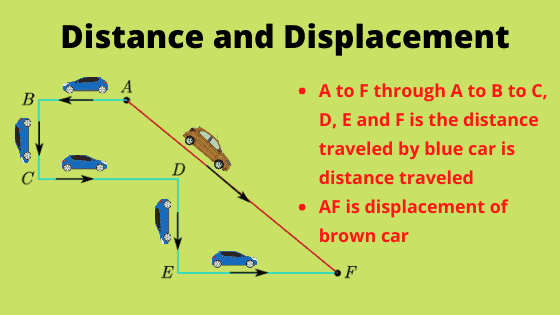
Level: Class 9 onward. Distance is a scalar: the total length of the actual path. Displacement is a vector: the shortest straight-line change in position from start to finish. Both are measured in metres (m) in the SI system.
| Basis | Distance | Displacement |
|---|---|---|
| Type | Scalar | Vector |
| Direction | Not specified | Must be specified |
| Sign | Positive or zero | Positive, negative or zero |
| Depends on path? | Yes | No, only on end points |
| On returning to start | Equals total path length | Zero |
| Relation | |displacement| ≤ distance, always | |
| Combined by | Ordinary arithmetic | Vector addition |
| From a graph | Total area under speed-time graph | Net signed area under velocity-time graph |
Notation: this page uses d for distance and Δx (or s) for displacement. Example: walk 3 m east then 4 m west. Distance = 3 + 4 = 7 m; displacement = 3 − 4 = −1 m, i.e. 1 m west.
→ Go Deeper: Distance and Displacement
6.1 Is displacement a vector or a scalar?
A vector. Displacements of 3 m and 4 m can combine to 7 m (same direction), 1 m (opposite) or 5 m (perpendicular), which shows they add by vector addition. Distances always add to 7 m.
→ Go Deeper: Is Displacement a Vector or a Scalar?
6.2 How to find displacement
Subtract initial from final position: Δx = xfinal − xinitial. The sign is the direction.
Method 1: from coordinates
Fix an origin and positive direction, then apply Δx = x₂ − x₁. For two perpendicular legs a and b, magnitude = √(a² + b²) and direction θ = tan⁻¹(b/a).
→ Go Deeper: How to Find Displacement in Physics
Method 2: from a position-time graph
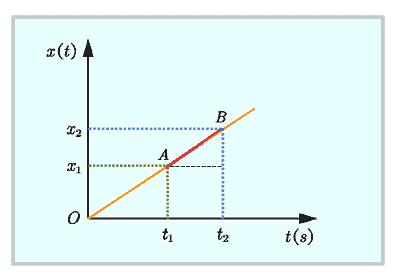
Read the position at the start and finish and subtract. It is the vertical change, not the length of the line. A horizontal segment adds zero displacement.
→ Go Deeper: Displacement on a Position-Time Graph
Method 3: from a velocity-time graph
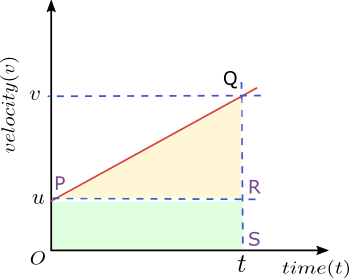
Displacement is the net signed area between the line and the time axis: area above counts positive, below counts negative. Add absolute values of the areas to get distance.
→ Go Deeper: Displacement on a Velocity-Time Graph
7. Reading Graphs of Motion
Level: Class 9 onward. The slope of a position-time graph is velocity; the slope of a velocity-time graph is acceleration; the area under a velocity-time graph is displacement.
| Graph shape | Position-time graph means | Velocity-time graph means |
|---|---|---|
| Horizontal line | At rest | Constant velocity, zero acceleration |
| Straight sloping line | Constant velocity | Constant acceleration |
| Curve | Velocity changing (accelerated motion) | Acceleration changing |
| Line below the axis | Position negative | Moving in the negative direction |
8. Speed, Velocity and Acceleration
Level: Class 9 onward. These three quantities describe how an object moves; kinematics studies them without asking what causes the motion.
| Quantity | Definition | Formula | Type | SI unit |
|---|---|---|---|---|
| Speed | Distance per unit time | speed = total distance ÷ total time | Scalar | m/s |
| Velocity | Displacement per unit time | v = Δx ÷ Δt | Vector | m/s |
| Acceleration | Change of velocity per unit time | a = (v − u) ÷ t | Vector | m/s² |
Acceleration occurs whenever speed or direction changes. Average speed and average velocity differ whenever the path is not a straight line without reversal (see Problem 3).
→ Go Deeper: Speed Equation in Physics
9. Common Misconceptions
- “Distance and displacement are the same.” They match only for straight-line motion without reversal.
- “Zero displacement means no motion.” A lap of a track gives zero displacement and non-zero distance.
- “Constant speed means no acceleration.” Only in a straight line; a change of direction is an acceleration.
- “Something must be absolutely at rest.” Rest is always relative to a chosen frame.
- “A pseudo force is a real push.” It appears only in a non-inertial frame and has no source object.
10. Worked Problems
Problem 1
A student walks 4 m east, then 3 m north. Find the distance and the displacement.
Solution: Distance = 4 + 3 = 7 m. The legs are perpendicular, so |s| = √(4² + 3²) = 5 m, and θ = tan⁻¹(3/4) = 36.87°. Displacement = 5 m, 36.87° north of east. Check: 5 m ≤ 7 m.
Problem 2
A particle moves along the x-axis with these recorded positions. Find the total distance and the displacement over 10 s.
| t (s) | 0 | 4 | 6 | 10 |
|---|---|---|---|---|
| x (m) | +2 | +10 | +10 | −4 |
Solution: Distance = |10 − 2| + 0 + |−4 − 10| = 8 + 0 + 14 = 22 m. Displacement = xfinal − xinitial = −4 − 2 = −6 m, i.e. 6 m along the negative x-axis.
Problem 3
A cyclist rides 6 km east in 30 min, then 8 km north in 30 min. Find the average speed and average velocity.
Solution: Distance = 14 km in 1 h, so average speed = 14 km/h. Displacement = √(6² + 8²) = 10 km at tan⁻¹(8/6) = 53.13° north of east, so average velocity = 10 km/h in that direction. The two differ because the path is not straight.
11. Try This Yourself
- An athlete runs one and a half laps of a circular track of radius 35 m (take π = 22/7). Find the distance and the magnitude of displacement.
- A car travels 120 m north in 15 s, then 50 m south in 10 s. Find the distance, the displacement, and whether the motion is uniform.
- A lift starts from rest, accelerates up for 3 s, moves at constant velocity for 5 s, then decelerates to rest. When is it an inertial frame?
- A body moves at 5 m/s for 8 s, then reverses at 5 m/s for 4 s. Use the velocity-time graph to find the displacement.
Show answers
- Distance 330 m; displacement 70 m (the athlete ends diametrically opposite the start).
- Distance 170 m; displacement 70 m north; non-uniform, because the speeds are 8 m/s and 5 m/s.
- Inertial only during the 5 s at constant velocity; non-inertial while accelerating and decelerating.
- 5 × 8 − 5 × 4 = 20 m in the original direction.
→ Practice more: Distance and Displacement Questions · Questions About Motion with Answers
12. Quiz
Q1. A passenger in a moving bus is at rest with respect to: A. the road · B. a roadside tree · C. the bus seat · D. an overtaking cyclist
Q2. Which is a non-inertial frame? A. train at constant 80 km/h on straight track · B. car taking a turn at constant speed · C. the ground, treated as stationary · D. spacecraft drifting with engines off
Q3. An object returns to its start after a closed path of 400 m. Its displacement is: A. 400 m · B. 200 m · C. zero · D. cannot be determined
Q4. In uniform rectilinear motion the position-time graph is: A. a curve of increasing slope · B. a straight line with constant slope · C. a horizontal line · D. a parabola
Q5. Displacement from a velocity-time graph is found from: A. the slope · B. the length of the line · C. the net signed area · D. the y-intercept
Answer key
1 → C · 2 → B · 3 → C · 4 → B · 5 → C
13. Frequently Asked Questions
What is motion in physics?
Motion in physics is the change in position of an object with respect to a chosen frame of reference over time. It is always described relative to an observer, so it is a relative, not absolute, concept.
Why is motion relative?
Position can only be measured from a chosen origin, and no frame of reference is absolutely at rest. Different observers therefore assign different positions to the same object and can disagree about whether it is moving.
Can an object be at rest and in motion at the same time?
Yes. A passenger seated in a moving train is at rest with respect to the train and in motion with respect to the platform. Both descriptions are correct because each uses a different frame of reference.
What is the difference between distance and displacement?
Distance is a scalar equal to the total length of the path travelled. Displacement is a vector equal to the shortest straight-line change in position from start to finish. The magnitude of displacement is always less than or equal to the distance.
What is the difference between speed and velocity?
Speed is the distance covered per unit time and is a scalar. Velocity is the displacement per unit time and is a vector, so it includes direction. A car moving round a circle at constant speed has a changing velocity.
What are the types of motion?
By path: rectilinear, curvilinear, circular, rotational and oscillatory motion. By rate: uniform motion, where equal distances are covered in equal times, and non-uniform motion, where they are not.
14. Where to Go Next
Describing motion (kinematics) comes first; explaining its cause (dynamics) follows.
- Kinematics: the parent guide for all motion topics.
- Vectors in Physics: needed for displacement, velocity and acceleration.
- Force and Laws of Motion: why motion changes.
- How Does Force Affect Acceleration?
- Physics Formulas: a quick reference for motion equations.